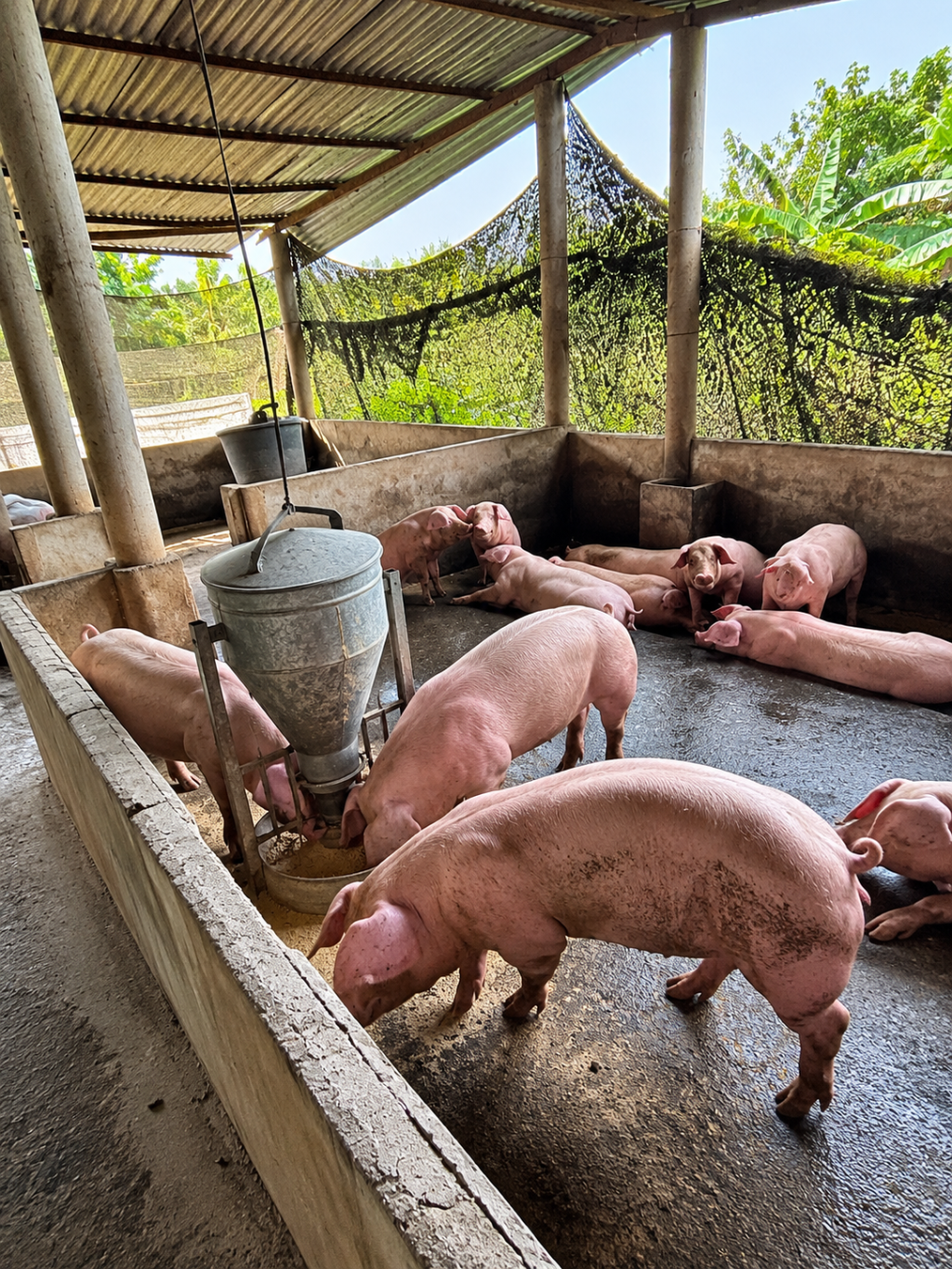
The pigs were already big when I visited the farm.
At around 90–100kg, they were at a weight when most pig farmers in Vietnam would normally be preparing to sell. But these pigs had only recently arrived.
They were going to be grown further.
The farm itself gave few clues that this was a specialized business. The pens were simple, the facilities basic. The pigs would not be staying long.
I sat down with the operator to understand why someone would buy a pig that was already ready for market, feed it for another month, and try to sell it again at around 130kg or more.
Her answer was a calculation.
A different equation
Known in Vietnam as nuôi heo gột, pig refattening occupies a small and unusual space in the live pig market.
For conventional pig farms, keeping finished pigs longer is not necessarily attractive. Feed efficiency changes as pigs become heavier, carcass composition and market requirements begin to matter, while keeping pigs in the barn also delays the next production cycle. Disease and market risks continue for as long as the pigs remain on the farm.
Gột operators work with a different equation. They deliberately enter at this late stage, buying finished pigs and betting that the additional weight can still be produced and sold profitably.
The operator I visited bought pigs at around 90–95kg and kept them for about a month. By the time they left, they normally weighed around 130kg. She estimated average daily gain at around 1kg.
But unlike a conventional farm raising pigs through a longer production cycle, she could decide whether that month was worth buying at all.
At the time of my visit, she described buying pigs at VND 48,000/kg and selling at VND 61,000–63,000/kg. But the selling price ultimately depended on the market when the pigs were ready.
That made the calculation deceptively simple.
Buy a finished pig. Add kilograms. Sell those kilograms into a different market.
The difficult part was everything that could happen in between.
Every kilogram counts
The operator had roughly one month to work with.
A pig that grew slowly could stay below the weight she expected. Pigs could also lose several kilograms after transport and relocation, meaning she first had to recover weight before producing new kilograms she could sell.
And she was not starting with a piglet. She had already paid for an animal at conventional market weight.
That made me look differently at the pigs in her pens.
The important question was no longer simply whether a 100kg pig could become a 130kg pig. Clearly, it could.
The question was which pig could produce those additional kilograms efficiently enough to make the calculation work.
For that, the pig she bought mattered.
Dr Shepherd, the pseudonym of an experienced swine genetics and production specialist who has worked extensively in Vietnam, advised gột operators to pay close attention to the origin and condition of incoming pigs.
He favored pigs from well-managed production systems with good nutrition and disease control, and emphasized health and uniformity. Genetics also mattered because pigs did not necessarily continue growing or depositing additional weight in the same way once they moved beyond conventional market weight.
His advice made the sourcing decision look less like simply buying pigs and more like buying their remaining growth potential.
There was another complication. Gột farms repeatedly bring in mature pigs from elsewhere and move them out again after a short period. Dr Shepherd warned that this turnover increases opportunities for disease to move between batches, making isolation, disinfection and health monitoring particularly important.
For a business built around a one-month window, losing days is expensive. Losing the pig is worse.
Feeding the final kilograms
Feed is the other side of the calculation.
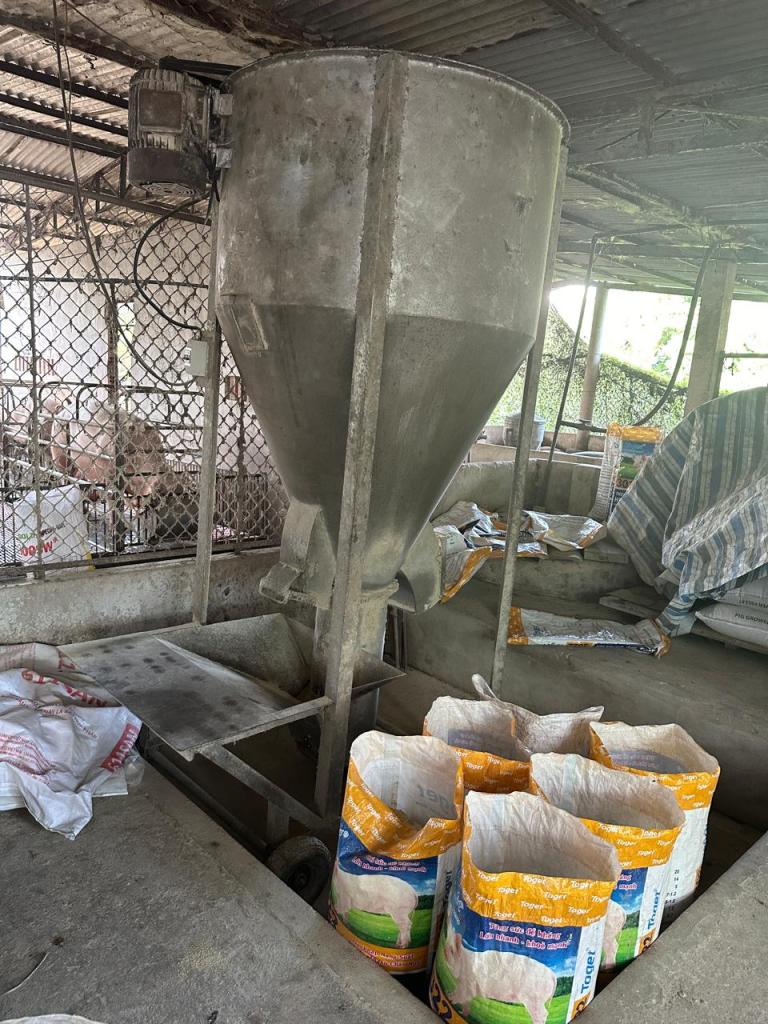
The operator mixed her own ration, using ingredients including fishmeal. She paid attention even to differences among fishmeal sources, saying some were saltier or less palatable to the pigs than others.
Another experienced gột operator in Dong Nai told PigTalks that self-mixed feed could cost about 10% less than commercial feed of comparable quality. At the time, he estimated commercial feed for pigs of 60–100kg at VND 10,900–11,500/kg, compared with around VND 9,800–10,300/kg for a self-mixed ration.
That saving matters when a mature pig can eat several kilograms of feed a day.
But cheaper feed alone does not make the model work. The operator still needs those kilograms of feed to produce enough valuable kilograms of pig.
And this is where the biology becomes more complicated than the calculation.
The last 30kg: What changes?
Pigs can continue gaining substantial weight beyond 100kg, but that does not mean they become more feed-efficient.
Research following pigs through the 100–130kg stage found that their nutritional needs changed as they became heavier. They required a lower concentration of lysine, an essential amino acid for lean muscle growth, than pigs in the 75–100kg stage.
Heavier pigs also eat more. So a lower nutrient concentration does not necessarily mean lower feed use per kilogram gained.
For the gột operator, that distinction matters: a cheaper ration may be possible, but the final kilograms still have to pay for the feed used to produce them.
Why make the pig bigger?
There was still one question bothering me.
If a 100kg pig is already perfectly suitable for slaughter, who wants the extra 30kg?
That question takes us to the other end of the gột business.
The heavier pigs do not necessarily return to exactly the same market they left. They can serve processing businesses looking for different carcass and meat characteristics.
One gột operator told PigTalks that pigs around 90kg were grown to around 130kg for chả lụa, Vietnam’s traditional pork sausage. He said processors valued the meat for its firmer texture and binding characteristics.
The operator whose farm I visited also had her own buyers. She told me some pigs went “to the north,” although she did not know where they ultimately ended up.
That downstream demand changes the meaning of the extra weight.
A gột operator is not simply holding a finished pig and hoping the market price rises. She is taking an animal that already fits one market, adding another stage of production and trying to turn it into an animal wanted by another.
Price still matters enormously. So do feed costs, health, growth performance and the price paid for the original pig.
But there has to be someone willing to buy the animal at the other end.
The empty pen is also a decision
That may be the feature that separates gột most clearly from conventional pig production.
A conventional farm already has pigs moving through its production cycle. The gột operator can look at the price of finished pigs, feed costs, available animals, expected growth and the market for heavier pigs and decide whether to start another one-month cycle at all.
Sometimes the calculation says buy.
Sometimes it says wait.
Once the pigs leave the farm, therefore, perhaps the most important decision in the gột business begins again:
whether to fill the pen.


Leave a Reply