
Vietnam’s pig market is entering the second half of 2026 from an unusual position. Pig supply remains relatively comfortable and live pig prices have fallen considerably from their earlier highs. Yet some of the signals further upstream are beginning to point in another direction.
Piglet prices have weakened. Independent producers are increasingly cautious about restocking. African swine fever (ASF) has intensified in several parts of the country. Industry contacts report that many pigs placed for fattening earlier in the year have now moved through the market, while fewer new pigs are entering the production cycle.
None of this means Vietnam is heading for a pig shortage. The national herd remains large, commercial producers continue to invest, and conditions vary considerably between regions and production systems.
But it does raise a different question.
Could today’s comfortable pig supply be hiding a thinner production pipeline for the months ahead?
That is the question PigTalks is watching as Vietnam moves out of the seasonally weaker mid-year consumption period and toward the final months of the year.
How the market got here
Vietnam’s pig herd has continued recovering from the severe disruption caused by ASF in previous years, while production has increasingly shifted toward larger commercial farms.
Official and industry estimates differ depending on timing and definition, one reason herd numbers should be treated as reference points rather than a precise real-time picture of animals available to the market.
What is clearer is the movement in prices.
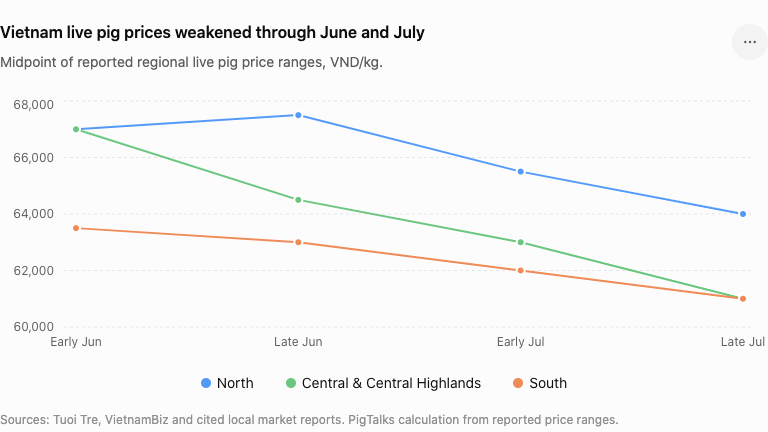
Live pig prices remained relatively strong entering June. In northern Vietnam, reported prices were around VND 66,000–68,000/kg in early June, while the Central and Central Highlands were at similar levels. Southern prices were somewhat lower at VND 62,000–65,000/kg.
By late July, the picture had changed.
Northern prices had fallen to around VND 63,000–65,000/kg, while much of the Central, Central Highlands and South were trading around VND 60,000–62,000/kg.
The correction was therefore not uniform. Based on the midpoint of reported regional ranges, prices declined by around 4–5% in the North and South between early June and late July, compared with approximately 9% in the Central and Central Highlands.
Several forces appear to have converged.
Domestic pork demand entered its seasonally weaker period as schools closed for summer and Vietnam approached the seventh lunar month, when vegetarian consumption traditionally increases. Dong Nai Livestock Association Chairman Nguyen Tri Cong has also pointed to these seasonal factors when explaining the recent weakness in pig prices.
Meanwhile, ASF activity increased sharply.
The renewed disease pressure came alongside tighter enforcement against the use of banned substances, particularly salbutamol. Together with weaker prices, these pressures appear to have encouraged caution among producers and, in some cases, earlier selling.
The result was a market carrying plenty of pigs just as consumption weakened.
Piglet prices point to more cautious restocking
One of the more interesting signals is appearing not in the slaughter market, but several months upstream.
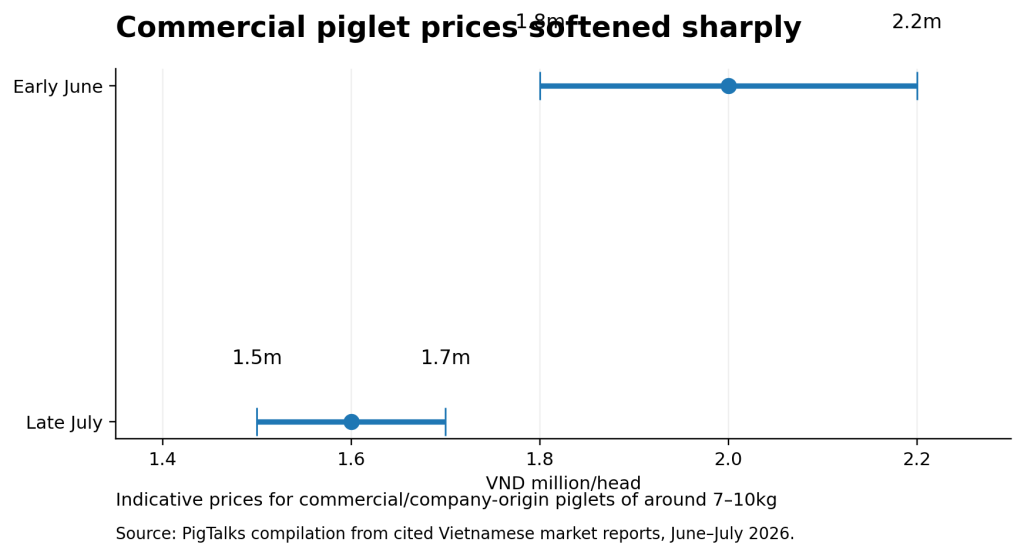
Commercial piglets of around 7–10kg were reportedly trading at approximately VND 1.8–2.2 million/head in early June, when demand for quality piglets was strong.
By late July, indicative prices had eased to around VND 1.5–1.7 million/head.
The two markets should not be interpreted as mechanically connected. Live pigs are sold by weight while piglets represent a separate market influenced by genetics, health status, source, availability and producers’ expectations about future profitability.
Nevertheless, the timing is significant.
As finishing-pig prices weakened and ASF risk increased, reports from the market indicated that independent producers became more reluctant to purchase piglets and begin another production cycle.
That observation is consistent with what PigTalks is hearing directly from the market.
One industry source told PigTalks in late August that many pigs placed for fattening earlier in the year had already been cleared. At the same time, fewer new pigs were being placed, while producers from small farms to larger operations remained hesitant to “catch the bottom” and restock.
The source also reported a declining volume of overweight pigs coming from company farms. In some local traditional markets, buyers had even begun approaching smaller farms looking for slaughter pigs.
He cautioned strongly, however, against extrapolating these localized movements to the national market.
That distinction matters.
Vietnam does not appear to be short of pigs today. Rather, some of the signals feeding the next production cycle are becoming softer.
ASF adds to restocking caution
By early July, nearly 700 ASF outbreaks had been reported across 28 provinces and cities, with more than 96,000 pigs dead or culled. Industry sources tell PigTalks that the actual number of affected pigs could be considerably higher than official reports indicate.
For the pig industry, ASF is never merely an animal-health statistic.
Its economic impact also comes from the decisions producers make when they believe the disease risk is rising.
A producer facing greater ASF risk may sell pigs earlier, delay bringing new piglets onto the farm, reduce stocking density or leave facilities empty while waiting for conditions to improve. This means ASF can affect both sides of the supply picture at different times: more pigs can enter the market today while fewer are being prepared for tomorrow.
Reports gathered by PigTalks during July and August suggest that disease concerns were among the factors discouraging restocking, alongside weaker live pig prices.
How long that caution persists may matter more to supply later in the year than the number of pigs currently moving through slaughter channels.
The sow number tells only part of the story
Vietnam’s sow population provides another reference point, although perhaps not the one it first appears to provide.
Some current estimates put the sow herd at around 2.1–2.2 million head. But PigTalks believes the headline number should be interpreted cautiously.
No individual genetics company, producer or industry organization has complete visibility over Vietnam’s productive sow population. Different sources measure different parts of the industry, and herd conditions can change considerably between statistical reporting periods.
More importantly, two sow herds of the same numerical size do not necessarily have the same production capacity.
Ownership is changing as commercial producers expand and smaller farms leave or reduce production. Genetics and reproductive performance also vary significantly between production systems. A smaller number of highly productive commercial sows can potentially produce more piglets than a larger population of lower-productivity animals.
For companies supplying genetics, feed, equipment and animal health products, the more useful questions may therefore be not only how many sows Vietnam has, but who owns them, how productive they are and whether producers are replacing them.
Current public information does not yet provide satisfactory answers to all three.
Commercial and independent producers may be moving differently
That uncertainty becomes particularly important because Vietnam’s pig industry is not moving as one unit.
Large commercial producers continue pursuing expansion plans and investing in modern production capacity. Independent producers, meanwhile, appear considerably more sensitive to the combination of lower pig prices, disease exposure and the financial risk associated with restocking.
Public reporting gathered by PigTalks points to continued investment by major companies even as smaller farms have become more cautious. However, announced expansion plans should not automatically be interpreted as evidence that commercial producers are increasing market supply immediately.
New farms, sow capacity and integrated projects take time to translate into slaughter pigs.
The more immediate question for the Market Pulse is therefore who is placing pigs now.
The weakening piglet market and observations from industry contacts suggest that at least part of the independent sector has become hesitant.
If that continues while commercial producers maintain their longer-term expansion, the current cycle could accelerate an already visible structural change in Vietnamese pig production: more production moving toward larger, integrated businesses while smaller independent farms become more selective about when, or whether, to restock.
Demand remains the other half of the equation
A thinner production pipeline does not automatically mean higher pig prices.
Demand will determine whether any future reduction in available pigs actually tightens the market.
Public reporting during the recent price decline pointed to slower pork movement through some wholesale channels, with traders reportedly reducing purchases as meat remained unsold for longer.
Some of this weakness is seasonal.
Schools are reopening, the seventh lunar month will pass, and pork consumption normally strengthens toward the final months of the year. Whether that seasonal recovery is strong enough to materially change the supply-demand balance remains to be seen.
Imports add another variable.
Vietnam imported about 494,300 tons of meat and meat products during the first half of 2026, up nearly 10% in volume year-on-year. That figure covers all meat and meat products, not pork alone, and therefore should not be interpreted as direct pork supply.
Imported frozen pork also competes differently from domestic fresh pork. Its influence is generally more relevant in processing, foodservice and institutional channels than in traditional fresh-meat markets.
For PigTalks, the important question is therefore not simply whether imports are rising, but where that additional meat is competing with domestic pork and whether it limits the effect of recovering domestic demand on pig prices.
Feed costs offer little certainty
Feed markets are not yet giving producers a clear reason for confidence either.
Industry information collected in August showed cautious purchasing of corn and soybean meal, with buyers reluctant to accept some offers and waiting for clearer price direction. Rice bran prices, meanwhile, showed different movements depending on grade and location.
This does not yet point to a single feed-cost direction.
For producers deciding whether to restock, however, uncertainty itself matters. A new pig placed today represents a bet on the relationship between feed costs, disease risk and the live pig price several months from now.
At the moment, many independent producers appear unwilling to make that bet aggressively.
What the signals tell us
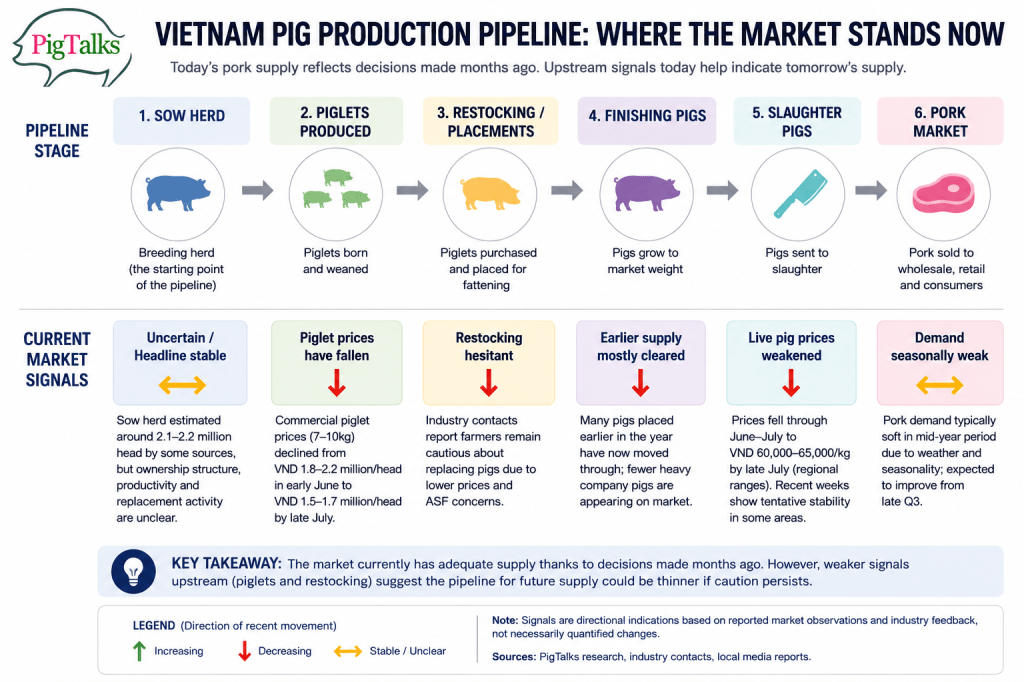
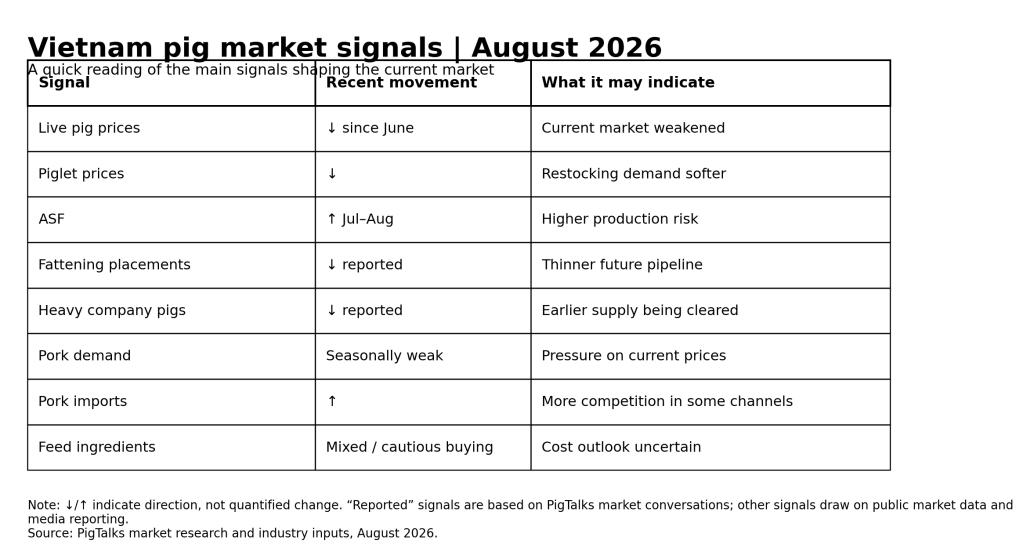
Taken together, the market signals describe something more nuanced than either “oversupply” or “shortage.”
Vietnam currently appears to have sufficient slaughter-pig supply. Prices have corrected sharply from earlier levels, demand has been seasonally weak and pigs placed into production months ago continue moving through the market.
But further upstream, the picture is less comfortable.
Piglet prices have fallen. Producers are reportedly cautious about restocking. ASF has increased production risk. Industry contacts are seeing fewer new pigs entering some fattening channels, even while large commercial companies continue longer-term expansion.
None of these signals alone predicts Vietnam’s pig supply several months from now.
Together, however, they justify watching the production pipeline more closely than the current slaughter-pig number.
What PigTalks is watching next
Over the coming months, PigTalks will be watching whether piglet prices stabilize and demand for commercial piglets returns; whether independent producers begin restocking as ASF pressure and seasonal demand conditions change; whether the reported decline in heavy company pigs persists; and whether improving pork consumption translates into stronger slaughter-pig prices.
We will also watch replacement activity in the sow herd. Changes in gilt demand and commercial sow expansion may tell us more about Vietnam’s future production capacity than a single national sow estimate.
For now, the Vietnamese pig market is neither clearly tightening nor simply oversupplied.
It is in transition.
And the most important signals may be appearing several months before the pigs themselves reach the market.


Leave a Reply