
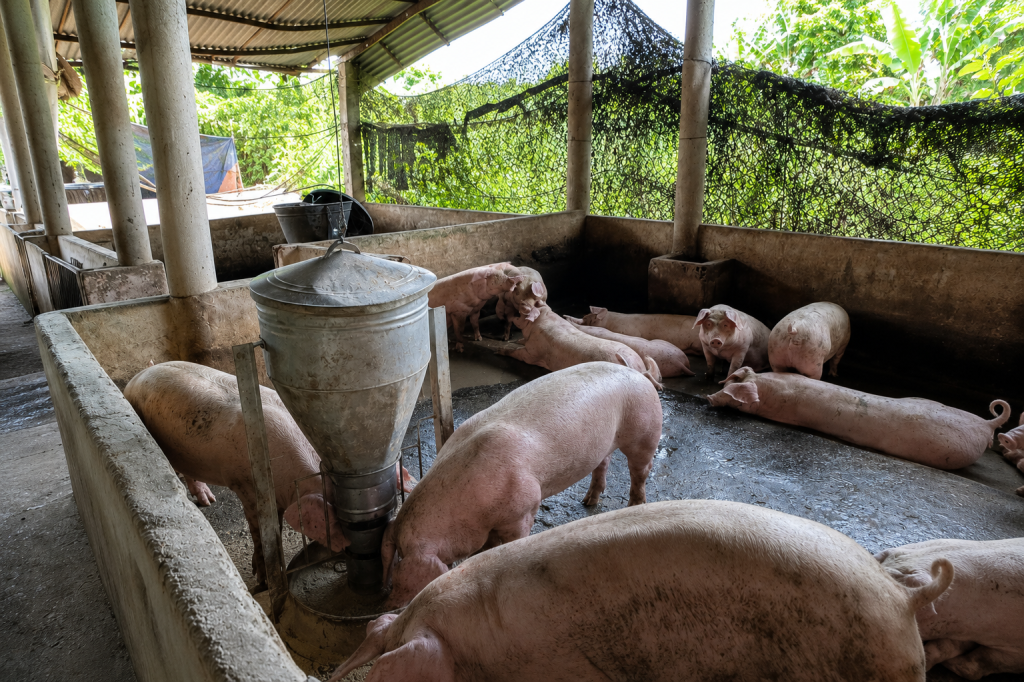
Vietnam’s pig sector is becoming increasingly industrialized, but technology adoption does not happen in one leap from a conventional farm to a fully automated production system.
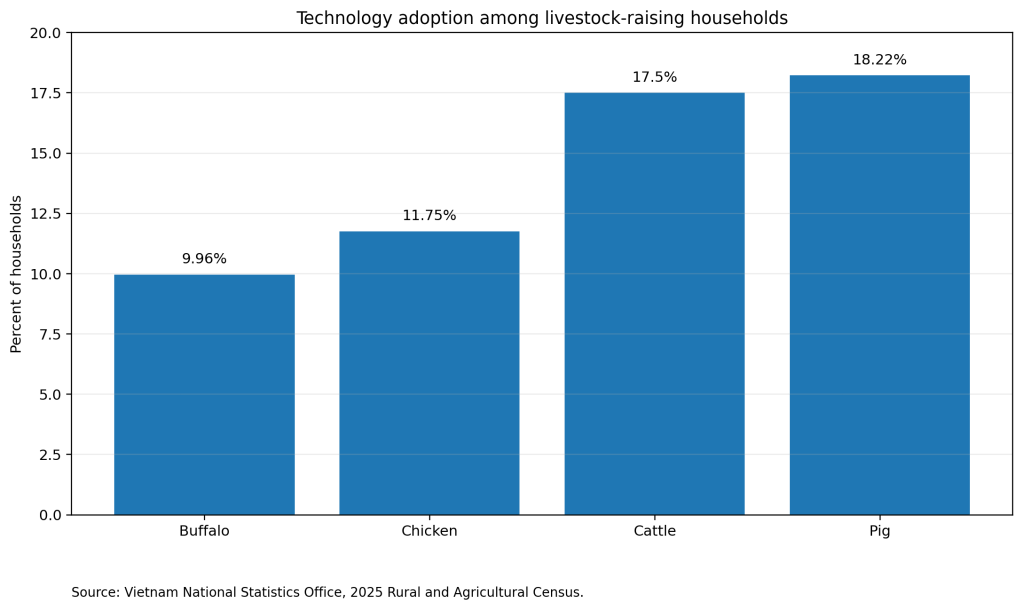
New data from Vietnam’s 2025 Rural and Agricultural Census show that 18.22% of pig-raising households apply livestock technologies, the highest rate among the major livestock categories covered by the census. The corresponding rates were 17.5% for cattle, 11.75% for chickens and 9.96% for buffaloes.
However, a second figure in the same census provides a more nuanced picture of what technology adoption means on Vietnamese pig farms.
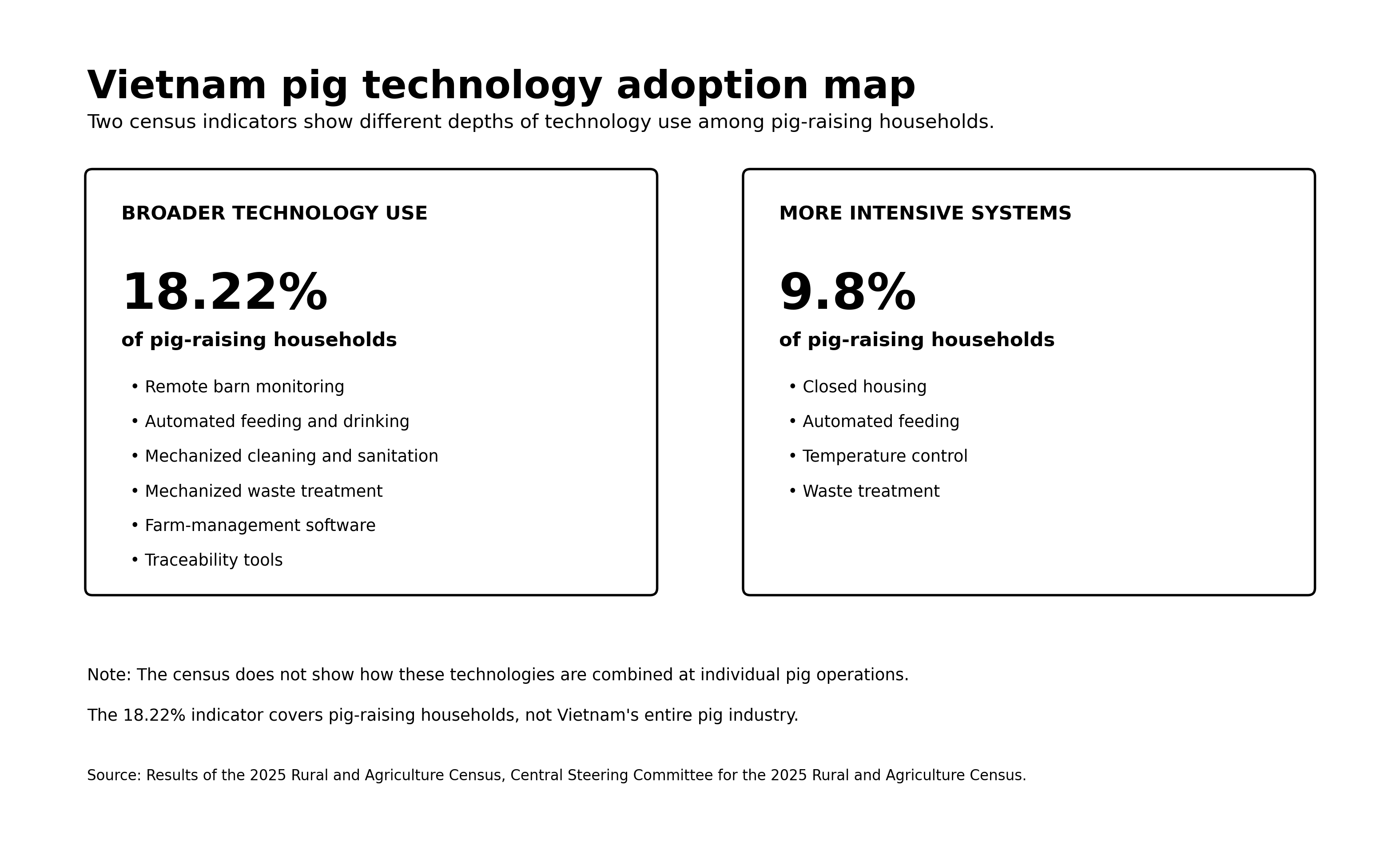
When the National Statistics Office (NSO) looked at a narrower group of technologies including closed housing, automated feeding, temperature control and waste treatment, adoption among pig-raising households stood at 9.8%.
The gap between the two figures suggests that technology adoption in Vietnam should not be viewed simply as a division between traditional and modern farms.
Technology does not come as one package
The broader 18.22% measure covers technologies ranging from remote barn monitoring and automated feeding and drinking to mechanized cleaning, waste treatment, farm-management software and traceability systems.
This means a farm counted as using technology does not necessarily operate a closed-house production system.
That distinction reflects how investment can occur in practice in Vietnam. Independent producers may improve individual parts of their production systems without rebuilding an entire farm. Automatic feeding or drinking, for example, can be introduced in farms that continue to use open or semi-open housing. Other producers may invest in cooling, waste treatment or monitoring before moving toward more integrated systems.
The census does not show how individual technologies are combined at each pig farm, so the difference between the 18.22% and 9.8% rates cannot be used to quantify this intermediate market. It does, however, show that technology adoption extends beyond farms using the more intensive group of housing, automation and environmental-control technologies.
For equipment suppliers, this distinction matters. Vietnam’s technology market is not limited to greenfield projects or complete closed-house systems. Producers can be at very different stages of mechanization and automation.
Technology adoption at ‘households’
There is an important qualification when reading the census figures. The 18.22% adoption rate applies specifically to pig-raising households, rather than Vietnam’s entire pig-production sector.
In Vietnamese agricultural statistics, however, a “household” should not automatically be understood as a backyard producer. Household pig production covers operations of different scales, and the segment itself is becoming larger. The census shows that the proportion of pig-raising households keeping at least 50 pigs increased from 2.55% in 2016 to 4.16% in 2025.
At the same time, Vietnam’s commercial pig sector includes large farms and enterprises operating increasingly industrialized production systems. These are important parts of the equipment market but are not represented by the 18.22% household technology-adoption indicator.
Why adoption remains uneven
The NSO identifies several barriers to greater technology and mechanization at household level, including small and fragmented production scale, limited financial capacity, high investment costs and limitations in farmers’ ability to access and operate new technologies. It also points to uneven technology-transfer support.
These constraints help explain why technology adoption can develop in stages rather than through complete farm conversion.
| NSO finding | PigTalks reading |
| 18.22% | Broad technology adoption among pig-raising households |
| 9.8% | More intensive housing, automation and environmental-control technologies have narrower penetration |
| 2.55% → 4.16% | Larger-scale production is increasing within the household segment |
The opportunity therefore cannot be read simply as the 81.78% of pig-raising households not captured by the census’s broader technology indicator. Farm scale, production model, existing equipment and investment capacity all determine what technology is relevant to a particular producer.
What the census does reveal is a pig sector in which technology adoption has several layers. The 18.22% and 9.8% figures provide two different windows into that development, and a reminder that modernization in Vietnam does not necessarily arrive as a complete farm system.
By Ha Thu
PigTalks Asia


Leave a Reply