
Two recent studies from Vietnam and Thailand offer a closer look at the reproductive performance of Landrace × Yorkshire sows under commercial production in Southeast Asia. Both also draw attention to a particular point in the sow’s productive life: the transition from first to second parity.
The results do not suggest that Landrace × Yorkshire genetics are themselves responsible for poorer second-parity performance. Rather, they show how differently performance can look depending on what is measured, and raise useful questions about how the productive potential of modern maternal sows is supported through their early parities.
Thai sows increase output toward P3
A study published in Theriogenology in 2026 analyzed 41,288 litters from 11,301 hyperprolific Danish Landrace × Yorkshire sows in a commercial herd in western Thailand. The research was conducted by scientists from Chulalongkorn University.
Across the population, the sows averaged 16.5 total born and 14.6 born alive. Litter size increased from P1 through P3, with total born reaching a peak of 17.7 piglets at P3 before declining from P4.
This suggests that P1 does not represent the productive peak for these sows. Their early parities are part of a continuing production curve, with considerable reproductive potential still to be expressed after the first farrowing.
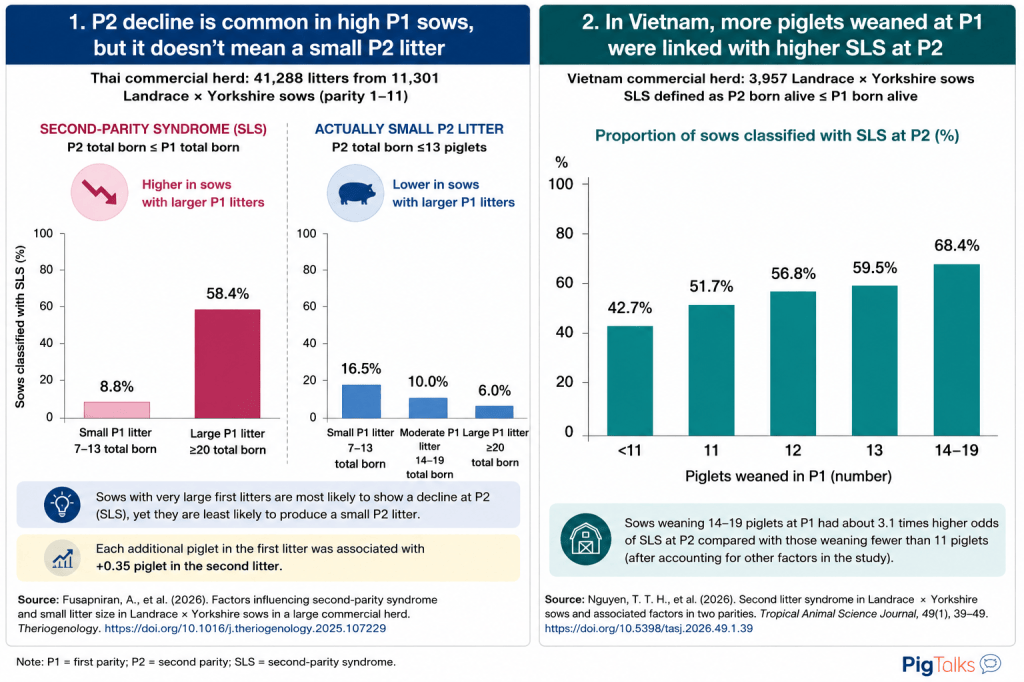
However, the researchers also observed second-parity syndrome in 34.9% of the sows, with affected females producing an average 3.4 fewer total-born piglets at P2 than at P1.
The likelihood was strongly related to P1 litter size.
Only 8.8% of sows producing 7–13 total-born piglets at P1 experienced second-parity syndrome. The proportion rose to 58.4% among sows producing 20 or more piglets at P1.
But another analysis in the same study provides important context.
When the researchers instead looked at the probability of producing a small P2 litter, defined as 13 or fewer total born, the relationship was reversed.
A small P2 litter occurred in 16.5% of sows with a small P1 litter, 10.0% of those with moderate P1 output, and only 6.0% of sows that had produced 20 or more piglets at P1.
Each additional piglet at P1 was associated with 0.35 additional piglet at P2.
In other words, the highly prolific P1 sows were more likely to show a decline between P1 and P2, but less likely to produce an objectively small litter at P2.
Vietnam data show another P1-P2 pressure point
The second study, published in Tropical Animal Science Journal, analyzed 3,957 Landrace × Yorkshire sows on a commercial farm in central Vietnam. The research involved scientists from Vietnam National University of Agriculture and Khon Kaen University.
The researchers classified second litter syndrome as P2 number born alive being equal to or lower than P1. Under that definition, 56.8% of the sows were affected.
Mean number born alive was 12.7 at both P1 and P2.
One of the clearest associations was with the number of piglets weaned during the first lactation.
Among sows weaning fewer than 11 piglets, 43% met the second-litter-syndrome definition. The proportion increased to 52% among those weaning 11 piglets, 57% at 12, 60% at 13 and 68% among sows weaning 14–19 piglets.
In the researchers’ multivariable model excluding P1 number born alive and litter birth weight, sows weaning 14–19 piglets had about 3.1 times the odds of second litter syndrome compared with those weaning fewer than 11.
Litter weight at weaning showed a similar pattern in the univariable analysis. Second litter syndrome occurred in 44% of sows whose P1 litter weighed less than 70 kg at weaning and 65% of those whose litter exceeded 100 kg.
The authors discussed greater physiological demand during first lactation as one possible explanation. However, individual sow feed intake, body weight change, backfat loss and body condition during lactation were not measured, so the study could not establish the mechanism behind these associations.
The same decline can mean different things
Together, the two datasets make the P1-P2 transition particularly interesting.
The Vietnamese data show an association between greater P1 weaning output and a higher probability that P2 born alive will fail to exceed P1.
The much larger Thai dataset, meanwhile, shows why the direction of change alone needs careful interpretation. Sows with the largest P1 litters were most likely to record a P2 decline, yet they were also least likely to produce a small P2 litter.
A sow moving from 20 total born at P1 to 17 at P2 represents a decline. A sow moving from 10 to 11 represents an increase. The direction is different, but so is the absolute production.
These studies do not establish which nutritional, genetic or management interventions would best support Landrace × Yorkshire females through this transition. Nor do they establish a single explanation for second-parity underperformance.
What they do provide is recent commercial evidence from two major pig-producing markets in Southeast Asia showing where an important maternal line may not always follow a simple upward production curve between its first two parities.


Leave a Reply