
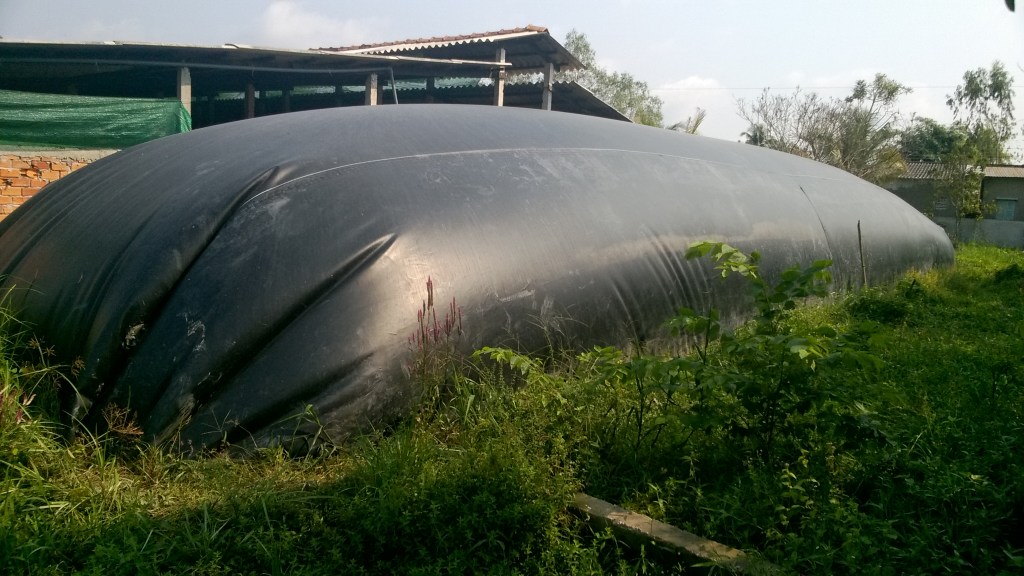
A covered biogas system capturing methane from pig manure at a farm in Binh Duong. As carbon credit rules take shape, such systems may need to move beyond treatment to verifiable emission reduction.
Vietnam’s new carbon credit framework is not just a policy headline. It quietly changes how value can be created inside livestock production.
At its core, the regulation formalises how emission reductions are measured, verified and traded.
But for farms, the shift is more practical: methane is no longer just waste — it becomes a measurable output.
This puts two areas under a new lens.
First, waste treatment systems.
Biogas is no longer only about compliance or odor control. To qualify for carbon credits, systems must be sealed, monitored and verifiable. That moves the discussion from “having a system” to “having a system that can produce data and value”.
Second, feed and nutrition strategies.
Emission reduction is not only at the end of the pipe. Feed formulation, digestibility and emission intensity now sit closer to cost calculation, not just performance metrics.
For solution providers, this is not yet a market. It is a signal.
Farms will not move because of carbon credits alone. The current economics of pig and poultry production are still tight, and additional compliance costs may come first before any revenue is realised.
But the direction is set: waste handling and feeding strategies are moving from operational choices to measurable assets.
Those who can connect emission reduction with real cost efficiency — not just certification — will be the ones the industry listens to.
By Ha Thu
PigTalks
 pigtalks.asia
Leave a comment