The first high-rise pig farming project is scheduled to commence in Tay Ninh in early 2026. Beyond Tay Ninh, projects are also being explored in Nghe An and Binh Phuoc. Alongside BaF Vietnam, several major domestic corporations, including Xuan Thien, Greenfeed, and Dabaco, are considering this innovative model.
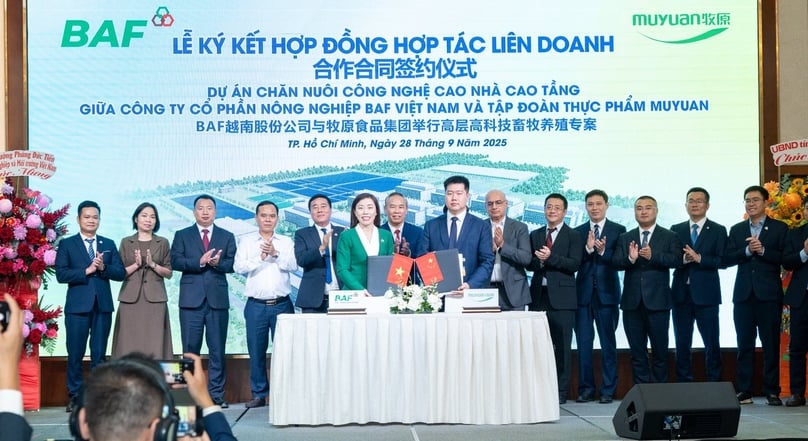
BaF Vietnam Agriculture (BaF Vietnam) has forged a joint venture with China’s Muyuan Foodstuff Group to develop and manage a cutting-edge pig farming project in Tay Ninh province. This ambitious initiative aims to accommodate 64,000 sows and produce an impressive 1.6 million market pigs each year, supported by a feed plant boasting a capacity of 600,000 tons annually. With an investment of USD 454.32 million, the project is projected to generate around USD 378.6 million in annual revenue.
Bui Huong Giang, CEO of BaF Vietnam, announced that the project would commence as soon as all necessary legal procedures were completed in accordance with the regulations. She highlighted the joint venture’s dedication to meeting deadlines.
“BaF has proactively formed a strategic partnership with Muyuan, a company with extensive experience in multi-story farm models and one of the world’s largest livestock enterprises. This high-rise pig farming project will play a key role in modernizing Vietnam’s livestock industry, ensuring a stable pork supply, and providing consumers with clean, safe, and competitively priced food,” stated Ms Giang .
Following its high-tech and sustainable agriculture vision, BaF aims to expand production to 10 million market pigs by 2030 – an ambitious goal in the context of Vietnam’s ongoing transition from small-scale traditional farming to large-scale, modernized livestock production.
Gao Tong, the CFO of Muyuan Foodstuff Group, highlighted that Muyuan possesses extensive experience in utilizing high-rise buildings for pig production.
“Since 2020, Muyuan has built 87 multi-story pig farms across 10 provinces in China, producing approximately 9.3 million pigs annually. The Tay Ninh project will apply Muyuan’s latest fifth-generation solutions, offering three key advantages, including land-use efficiency, biosecurity efficiency, and high-tech applications,” stated Mr Gao Tong.
Why choose a multi-story building model?
Muyuan and BaF identified several advantages of the model, explaining why they opted for it.
Land-use efficiency – A conventional farm housing 100,000 pigs typically occupies around 47 hectares. In contrast, the high-rise model in Tay Ninh is designed to utilize less than seven hectares, boosting land efficiency by more than six times.
Biosecurity efficiency – This project is crafted as a five-story “bio-secure island,” where each floor operates independently to mitigate the risk of cross-infection. The facility will be equipped with advanced air filtration, precision ventilation, and sophisticated disinfection and deodorization systems, achieving a remarkable 99.9% sterilization rate to curb disease spread.
High-tech applications – Intelligent environmental controls will ensure stable temperature and humidity throughout the year, significantly lowering the risk of disease. Smart feeding systems will adjust nutritional formulas daily based on the pigs’ age and weight.
Furthermore, intelligent robots will monitor 17 health indicators of the pigs around the clock, while AI-driven cough monitors will detect illnesses through sound and promptly issue alerts. “These innovative systems guarantee healthier pigs and enhance farming efficiency and sustainability,” the Muyuan executive stated.
Legal considerations in high-rise urban farming
Mr Phung Duc Tien, the Deputy Minister of Agriculture and Environment, announced that the government has approved the development of pig farming in high-rise buildings. He emphasized the need for ministries to establish effective mechanisms and policies, with a particular focus on environmental standards.
The current legal framework is quite supportive, featuring the Law on Animal Husbandry, two decrees, four circulars, and specific documents such as Decree 106, which aids both animal husbandry and the prevention of aquatic diseases (Decree 116). This comprehensive legal environment lays a solid foundation for the growth of pig farming in general, and high-rise pig farming in particular.
Additionally, the Ministry of Science and Technology has established standards for pig farming in high-rise buildings, supported by consensus documents from various ministries. This creates a robust technical and legal framework for effective implementation.
 pigtalks.asia
Leave a comment