
A decade ago, Hoa Phat Group (Hoa Phat) made a surprising entry into the agricultural sector. At the time, shareholders questioned the board of directors about whether this move was merely a trendy investment decision.
During the 2015 Annual General Meeting, Hoa Phat’s Chairman of the Board, Tran Dinh Long, reassured shareholders that the group was not merely chasing trends; rather, it was expanding in line with its core tradition—organizing the production and distribution of raw products at scale. Meanwhile, General Director Tran Tuan Duong noted the growing pressure from shareholders. Although Hoa Phat generated substantial profits annually, many shareholders expressed a desire for reinvestment rather than large dividends. The urgency for Hoa Phat to explore new product lines to secure future profits was increasingly apparent.
According to Duong, the blueprint for Hoa Phat in the agricultural sector was to capture a 10% market share of animal feed within ten years, positioning itself among the top five animal feed manufacturers in Vietnam. Fast forward ten years, and Hoa Phat took a significant step by conducting an initial public offering (IPO) and listing the Hoa Phat Agricultural on the stock exchange. This move came at a time when other agricultural companies from the same period, such as Hoang Anh Gia Lai Agrico (HAGL Agrico) and VinEco, had changed ownership.
Strategic timing
The group initially aimed to rank among the top five largest animal feed producers in Vietnam within ten years, but Hoa Phat Agriculture has only managed to secure a place in the top 13 of this sector. Yet, this does not overshadow the remarkable achievements that Hoa Phat has made in agricultural investments since its establishment a decade ago.
Throughout its journey, the company has encountered significant turning points, and the strategic decision to focus on livestock—particularly pig farming—has propelled Hoa Phat Agriculture to become one of the leading livestock enterprises in Vietnam.
Hoa Phat Agriculture holds approximately 25,000 sows. In the first nine months of 2024, the company reported sales of 443,000 finishing pigs, reflecting a remarkable 34% increase compared to the same period in 2023.
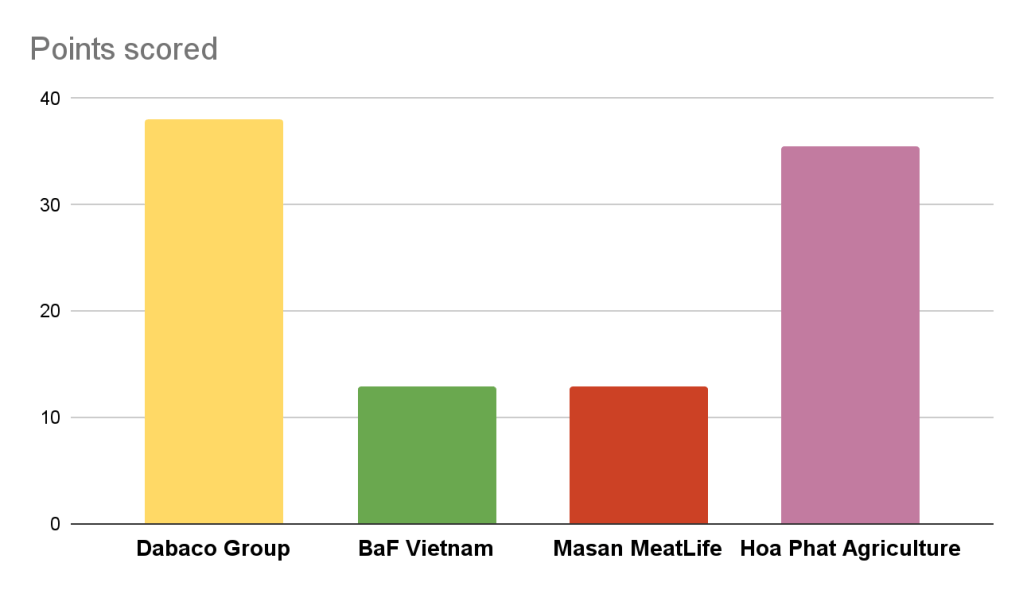
Financial reports for the first half of 2025 indicate that Hoa Phat Agriculture’s net revenue reached an impressive USD 160 million, surpassing that of BaF Vietnam, a major competitor in the southern region, which reported only USD 95 million in revenue during the same period. Hoa Phat’s revenue closely rivals that of Masan MeatLife, which generated USD 167 million. In comparison, Dabaco stands out with a notable net revenue of USD 281 million.
While all four businesses mentioned primarily operate in the livestock sector, comparing their revenues can be somewhat misleading due to the different dynamics of the animal feed and pig-poultry markets. However, when it comes to profits, Hoa Phat Agriculture stands out impressively. According to their report, in the first half of 2025, they achieved a post-tax profit of USD 35.5 million, which is 2.3 times what they made during the same period last year.
Recent reports suggest that in the first half of this year, while the pig farming segment accounted for only about half of Hoa Phat Agriculture’s total net revenue, it actually generated around two-thirds of the company’s profits. Furthermore, the animal feed segment, which is primarily focused on pig feed, also benefited from Hoa Phat Agriculture’s distribution efforts in pig breeding and the overall rebound of the pig farming industry. This situation sheds light on one of the main reasons behind Hoa Phat’s decision to go public and list on the stock exchange this year.
Pig farming becomes more interesting
The major players in the pig farming industry are currently enjoying a prosperous period, as pig prices have remained high for an extended time, largely due to the effects of ASF. This situation favors industrial livestock enterprises, which have a distinct edge not only because they can better manage disease control but also due to the stronger standards for pig farming set by the Animal Husbandry Law that comes into effect at the start of 2025.
Pig prices, however, cannot stay high indefinitely and tend to follow a cyclical pattern. Following the impact of ASF, farmers will rebuild their herds, leading to a gradual increase in pig supply. When the next commercial batches are sold, prices are likely to decline, which in turn will squeeze the profit margins for pig farming enterprises. Given this situation, Hoa Phat Agriculture needs to seize the opportunity when its performance is at its peak to raise capital and consider listing shares on the stock exchange.
In addition to these considerations, it’s evident that Hoa Phat Agriculture is poised to take advantage of the vibrant stock market, which presents robust liquidity and attractive valuations as it prepares for its IPO and plans to go public.
Hoa Phat Agriculture has not disclosed its anticipated IPO price, but they have indicated that the shares will be priced at no less than the book value, which stands at USD 0.45 per share as of June 30, 2025. However, it’s possible that the offering price could be significantly higher than this book value.
The reasoning behind this lies in the market capitalization of companies such as Dabaco, Masan MeatLife, and BaF, which fall within the range of USD 378 million to USD 492 million. Considering that Hoa Phat’s profits are on par with, or even exceed, those of these companies, it would not be surprising for Hoa Phat Agriculture’s market value after its IPO to align with this range. This suggests that the IPO share price could realistically be set at least three to four times its book value.
Source: dnse.com.vn
Translated and compiled by Ha Thu
 pigtalks.asia
Leave a comment