
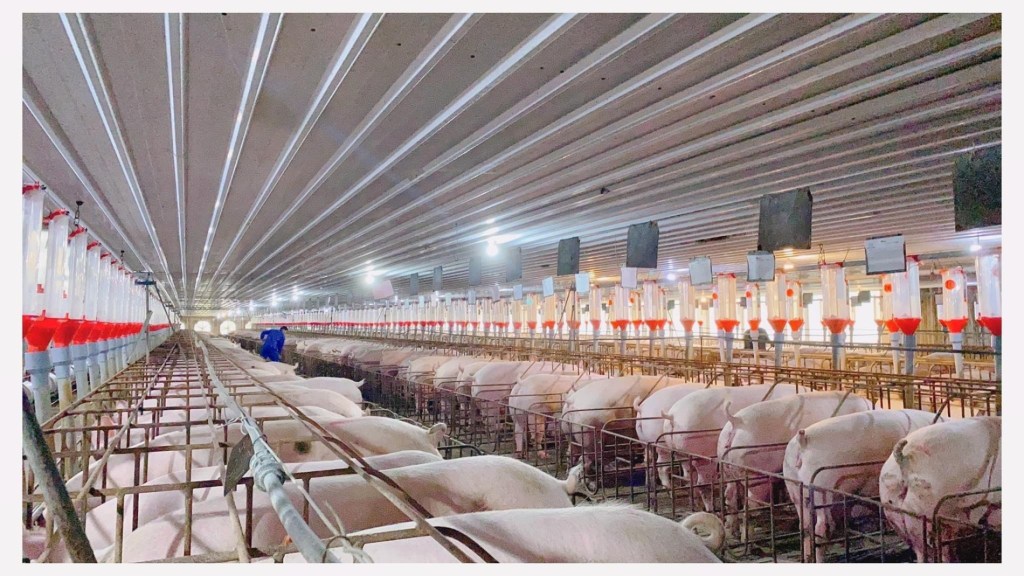
As larger companies, particularly integrators like Dabaco, BaF, and Masan, announced profit growth and expansion fueled by soaring pork prices, the market share from smaller-scale farms has diminished even further.
According to the Department of Animal Husbandry and Veterinary Medicine, pig production in small-scale farms is expected to decrease to 30% this year. This data so far indicates that the power of smaller producers is weakening.
Dr La Van Kinh, Vice Chairman of the Vietnam Feed Association (VFA), highlighted that out of the 2.2 million sows in the country, the top 10 enterprises account for 774,400, which is roughly 35% of the total population. While there are more small-scale farms, they account for only 26% of the overall sow count. This also suggests that many independent and smaller farms typically do not choose the farrowing-finishing farming model, opting instead to focus primarily on the general finishing model. This highlights a key issue: they lack ownership of the most vital aspect of pig farming—the breeding stock. As a result, their production costs are unable to compete with those of larger farms.
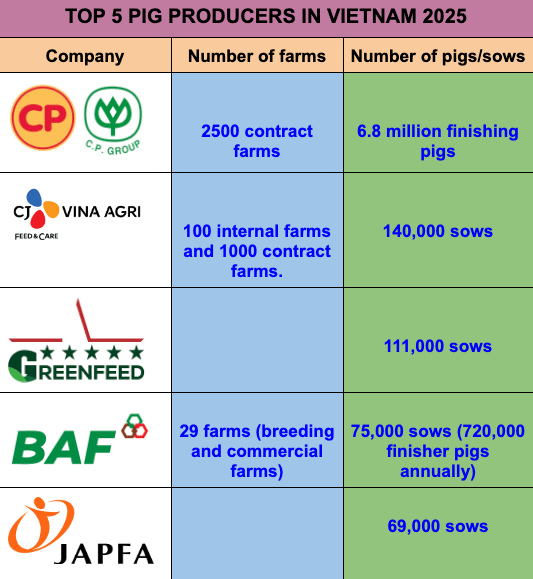
Over the past decade, there has been a notable increase in professional farming. This trend is underscored by the rapid growth of industrial feed production, which has been escalating at a rate of approximately 15-20% per year during this period. Consequently, we are witnessing a significant decline in backyard farming practices, along with a drop in the use of leftovers and homemade feed.
Precision farming leading the way
Small-scale farming often faces significant challenges, primarily due to high production costs, which stem from excessive losses, particularly in pig health and feed expenses.
Observations from Pigtalks found that small-scale farming households incur costs of USD 220 per kilogram for raising a 100-kg pig. Of these costs, feed makes up USD 140 (65%), while veterinary expenses amount to USD 10.75 (5%), covering essential vaccinations against Enzootic Pneumonia, CSF, PRRS, and FMD, as well as antibiotics and supplements. One significant factor that these farms often overlook is the mortality rate, which stands at 17%.
The costs associated with large-scale corporate farms can vary greatly. For instance, the total cost for a 100 kg pig is approximately USD 188, where feed expenses account for about 58% of this total, and can even be lower when working with integrators or utilizing precision feeding techniques that help minimize waste. Additionally, veterinary expenses typically amount to USD 9.4, which makes up roughly 5% of overall costs; these costs can be reduced in certain situations due to effective biosecurity measures and a good environment that minimizes stress. It’s also vital to note that the average mortality rate in these operations tends to hover around 12%.
Productivity has improved
Vietnam continues to rely significantly on imported breeding stock, though advancements in breeding knowledge have been made. Company-operated farms, which employ technicians, take better care of their sows compared to smaller farms that tend to be less productive.
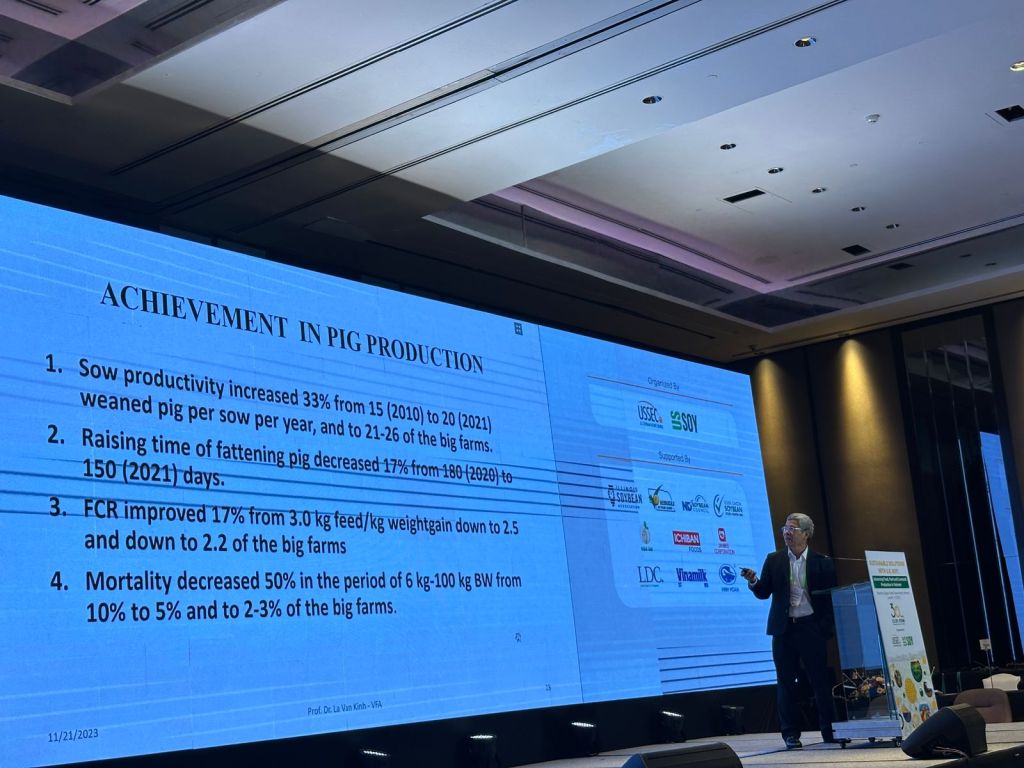
According to Prof Kinh, small farms currently average about 20 piglets/sow/year, while larger farms achieve around 26 piglets/sow/year. The mortality rate for piglets weighing 6 kg on small farms stands at 10%, whereas it drops to approximately 3% on larger farms.
Furthermore, the time it takes to rear pigs for sale is about 180 days on small farms, while larger operations can cut this down to 150 days. There is also a notable difference in feed conversion ratio (FCR), with small farms operating at 3.0 and larger farms at around 2.2, although Prof Kinh did not clarify whether this distinction pertains to home-mixed feed versus industrial feed.
Smart farming
The rise of smart farming technology has transformed the pig industry, making it no longer a field for amateurs.
Innovative farming equipment has been introduced in Vietnam since 2024, focusing on advancements like using sound to monitor pigs’ coughs for early disease detection, IoT sensor systems for microclimate monitoring, AI cameras for identifying unusual behavior, liquid feeding systems, and AI-driven feed mixing.
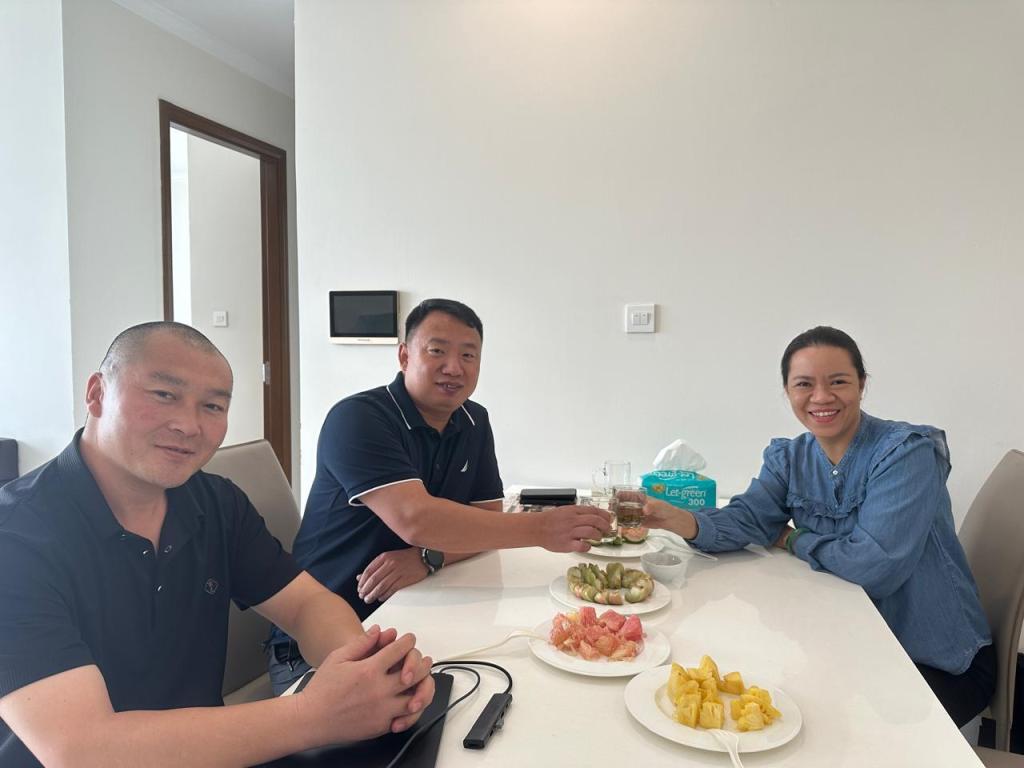
Recently, a Chinese company reached out to Pigtalks expressing their commitment to positively transforming the Vietnamese pig industry by addressing two critical issues: biosecurity and disease control.
They presented a comprehensive system aimed at enhancing biosecurity practices, which includes multi-dimensional disinfection methods for items entering the farm. Additionally, they introduced a sensor and automatic disinfection system that ensures personal hygiene protocols are followed precisely, both in terms of location and duration. Furthermore, they showcased rapid test kits for ASF testing, which deliver results with an impressive accuracy of up to 99% within just two hours.
On farms, systems designed for weighing pigs, managing herds, and automating feeding processes are gaining traction. These solutions not only help maintain biosecurity but also alleviate concerns about labor shortages in agricultural settings.
Lowered disease cost – Vietnam BaF case
At BaF Vietnam, an integrator in pig production, the cost to produce a 100 kg pig is only USD 185. Besides having the advantage of operating in a value chain, the company has good productivity results from its farming practices.
The company shared with Pigtalks that the investment in modern farm models that create comfortable environmental conditions for the pigs has paid off. This is one of the company’s methods to reduce disease costs.
The use of insulation boards to keep temperatures stable on the farms is also crucial. BaF uses different ventilation systems for different weather conditions. For the farms located in central Vietnam with hot dry weather, their ventilation system uses evaporative cooling pads to keep the pens cool. For farms located in northern Vietnam with hot and cold seasons, they have separate air conditioning systems to match weather conditions.
Responsible farming – Mavin case
The bigger a company grows, the more responsible it should become. Integrator Mavin Group has deployed its responsibility on many fronts.
Chairman David John Whitehead told Pigtalks that the journey has been challenging with them with a burden on increased costs when investing in environmental and social solutions. But these investments will pay off to make Mavin a stronger brand and a smarter-operated organization.
In 2019, Mavin won the Asian Feed Miller Sustainability Award for being the most sustainable livestock feed producer in Southeast and South Asia. They implement a “no waste” approach at their Dong Thap feedmill, recycling all manufacturing waste and minimizing air and noise pollution. Mavin aims to reduce water use by utilizing advanced Japanese wastewater treatment technologies and employs renewable energy sources like rice husk and sawdust for boiler operations. To improve energy efficiency, they use skylight roofs for natural lighting and gravity flow for ingredient dosing.
On their pig farms, waste is processed through a biogas system to create organic fertilizer, while automatic feeding systems lower labor costs and waste. They deliver feed directly to silos, reducing packaging costs and plastic waste. Mavin’s circular agriculture model features full-pit barn technology for better waste management, disease control, and biosecurity, reusing treated waste as fertilizer.

As the pig farming industry in Vietnam becomes increasingly professional, adapting to these changes is essential; otherwise, regression is unavoidable. Mr Whitehead noted that the livestock sector is evolving, marked by a decline in small farms and a rise in large-scale operations—a natural progression in any industry. However, the growth of larger farms doesn’t have to spell the end for smaller ones. The challenge lies in finding a balance that fosters the development of both.
This involves boosting the specialization of smaller farms while ensuring that large, concentrated production remains robust. Small farms can leverage niche markets, organic farming, and local produce to differentiate themselves and create unique value propositions. Furthermore, education and access to modern farming techniques and technologies can empower these smaller operations to thrive amidst increasing competition.
As leaders and supporters of the development of smaller farms, large companies must harness the principles of the circular economy to minimize losses and ensure cost efficiency. This means not only optimizing resource use but also engaging in partnerships that support sustainable practices and knowledge sharing. By developing mentorship programs, facilitating access to financial resources, and investing in community infrastructure, larger enterprises can create a more inclusive agricultural ecosystem where both large and small farms can coexist and mutually benefit.
Collaboration among stakeholders in the industry, including government bodies, agricultural experts, and farm cooperatives, is also crucial. Together, they can create policies that encourage sustainable growth, ensure fair market practices, and provide support systems that help small farms adapt to changing market demands. In this way, Vietnam’s pig farming industry can continue to innovate and flourish as a unified force, ensuring that every player—regardless of size—has the opportunity to succeed.
By Ha Thu
 pigtalks.asia
Leave a comment